UPSC Preparation · Coaching vs Self-Study
Self-Study vs IAS Coaching: Which Approach Works Better for UPSC Aspirants?
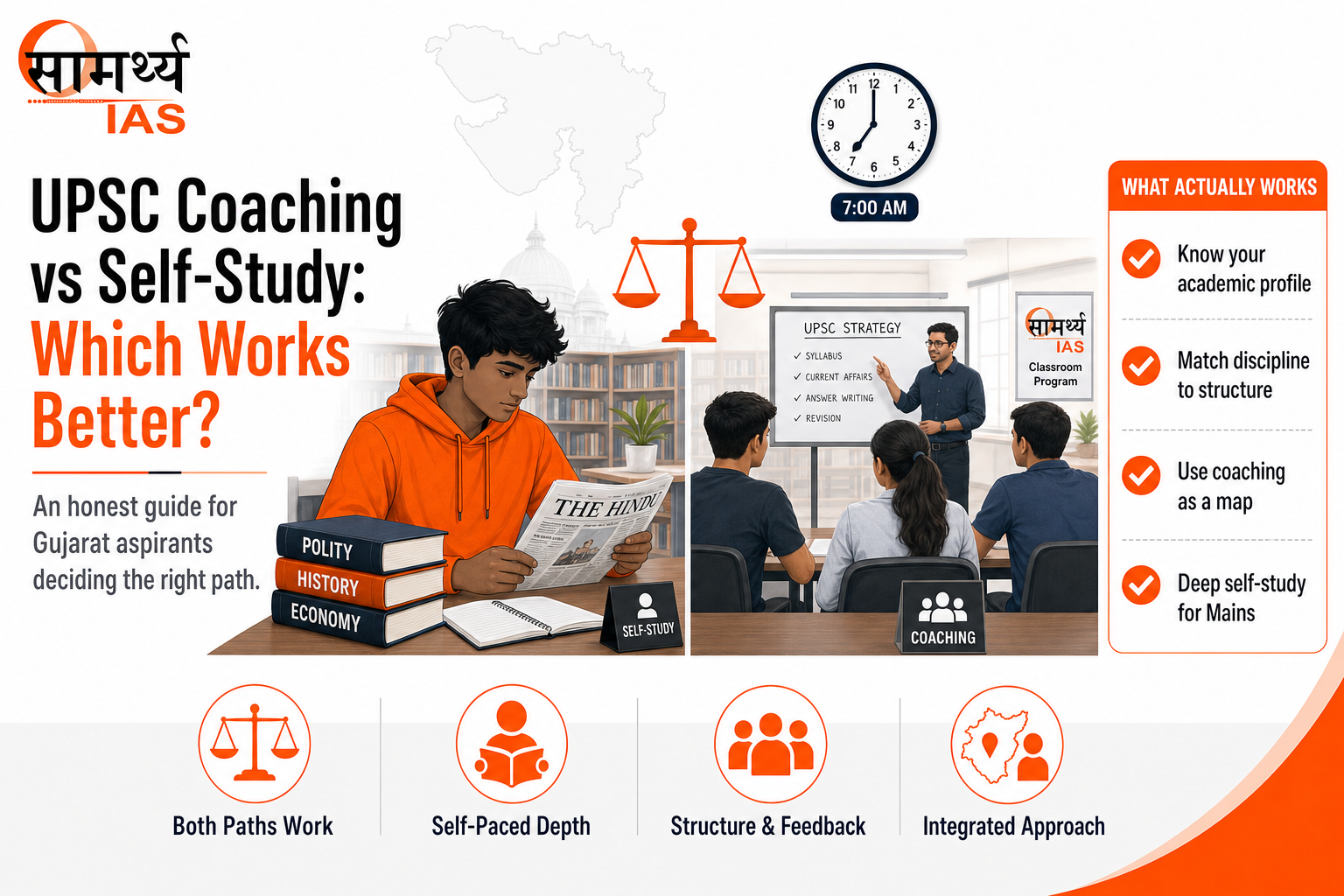
The controversy over UPSC coaching vs self-study has been going on for decades and continues to confuse aspirants because both sides have access to actual proof. There are indeed IAS officers who have never been to any coaching school. Equally skilled officers say that structured coaching created the foundation they needed to clear the exam. But who’s right?
Each approach works — but not for everyone, and not in the same circumstances. UPSC preparation is demanding enough that choosing the wrong study approach for your situation can add risk to an already challenging process. Understanding the factors that decide which route suits you is far more useful than a one-size-fits-all recommendation.
What the UPSC Examination Actually Demands From Any Preparation Approach
Before we compare UPSC coaching vs self-study, it is important to be clear about what the exam really requires. UPSC Civil Services has three stages: Prelims, Mains, and the Personality Test. Across this process you need a broad grasp of nine GS papers, deep command of an optional subject, mastery of current affairs, and the ability to write analytical answers under time pressure.
A single study approach cannot cover the entire range of demands. Self-study builds independent thinking and deep reading — which Mains answers reward. Coaching provides direction and external accountability, which many candidates need for early momentum.
What is the best way to prepare for UPSC is rarely one method alone. The most common successful pattern is a mix of both, matched to where you start and how you learn.
The Real Advantage Self-Study Offers That Coaching Cannot Replicate
Self-study is not just what people do when they cannot afford coaching. It is a preparation approach with real structural benefits that classroom programmes cannot fully replicate.
The UPSC syllabus rewards comprehension, not speed through a timetable. Self-paced students can spend three days on one Ancient History chapter until the interpretive structure clicks — instead of moving on because the batch schedule demands it.
Second is critical thinking. UPSC Mains answers are scored on quality of analysis, not volume of information. Students who have formed their own views on economy, governance, polity, and society through independent reading produce more original answers than those who have only absorbed coaching notes. The strongest answer scripts show thinking built by reading and reflection — not by attending more classes.
Third is cost and geography. UPSC preparation historically pushed aspirants to relocate to Delhi or Hyderabad for quality training. Self-study with strong online resources and a solid test series removes that need entirely. An aspirant in Surat or Vadodara following a disciplined daily programme is not at a structural disadvantage compared with a classroom in Mukherjee Nagar.
Where Coaching Delivers Value That Self-Study Struggles to Match
Recognising the benefits of self-study does not mean coaching has no role. Coaching fills real gaps.
Most important is structure at the start. A first-attempt aspirant who has never studied the UPSC syllabus faces a classic problem: not knowing what they do not know. The syllabus is vast, the resource ecosystem is noisy, and choosing what to study, in what order, and with which materials is hard without guidance. Coaching programmes remove that uncertainty by laying a clear path tested across many exam cycles.
Another is accountability. Many students who try pure self-study underestimate the discipline one to two years of preparation demands. Daily revision, answer writing, and current-affairs integration need a consistency that external structure often supplies more reliably than willpower alone. Class schedules, faculty interaction, and peer competition provide outside motivation many aspirants genuinely need.
Assessment with feedback is the third pillar. Mains writing improves through repetition and evaluation. A strong coaching programme offers regular writing practice with specific feedback from experienced evaluators. Pure self-study requires you to find quality test series and mentors or peers willing to assess answers honestly — harder than it sounds.
How to Decide Which Approach Fits Your Specific Profile
Instead of copying what toppers did, take a candid look at your present circumstances across four dimensions.
Academic background. Students with strong credentials and solid grounding in subjects like economics, history, or public administration usually find self-study more accessible than those learning these topics for the first time. If you are building basics from scratch, structured coaching can shorten the time spent figuring out fundamentals.
Discipline and study habits. If you already have a track record of sustained independent study, self-study for UPSC is a reasonable place to begin. If your academic life has always needed external structure for consistency, recreating that structure through coaching is the safer option.
Time and financial flexibility. For working professionals, offline coaching on a fixed schedule may not be practical. Online study with targeted support — a quality test series and focused advice on weak areas — usually fits better around a job.
Location and available resources. Candidates in Gujarat searching for IAS preparation support no longer need to assume that quality guidance requires relocating. An IAS preparation institute in Gujarat like Samarthya IAS offers structured UPSC training without uprooting your home base.
The Integrated Approach That Most Successful Candidates Actually Use
Looking at preparation patterns among successful IAS officers in recent years, a clear pattern emerges. Top performers rarely rely on one strategy alone. They use coaching for outline, syllabus orientation, and current affairs framing — while keeping most of their study hours for independent reading, revision, and answer writing.
Coaching sessions are attended for areas where guidance adds the most value, alongside large daily blocks for self-directed reading of textbooks, newspapers, and government publications. Coaching programmes provide the map. Self-study is where you learn the terrain.
If you are looking for the best way to prepare for UPSC within your schedule, location, and budget, Samarthya IAS offers a balanced method — organised guidance that supports, rather than replaces, the extensive independent work the exam ultimately rewards.
Conclusion
UPSC coaching vs self-study is not a binary choice with one right answer. The decision rests on your educational background, discipline patterns, finances, and where you are based.
What is clear: neither self-study nor coaching succeeds without consistent daily effort over a realistic timeframe. Structure is a supporting layer — not a substitute for the actual work.
Samarthya IAS works with UPSC candidates from Gujarat to find the right balance for their circumstances — organised preparation support that closes self-study gaps without restraining the independent mind the exam rewards. If you are near a decision, start by assessing where your current preparation is weakest and what kind of assistance would address that most effectively.
Coaching + self-study?
Find the balance that fits your profile
Talk to Samarthya IAS about a preparation plan that gives you structure where you need it — and space for the independent work UPSC rewards.