UPSC Coaching · Myths & Clarity
Common Misunderstandings About Civil Services Coaching Institutes
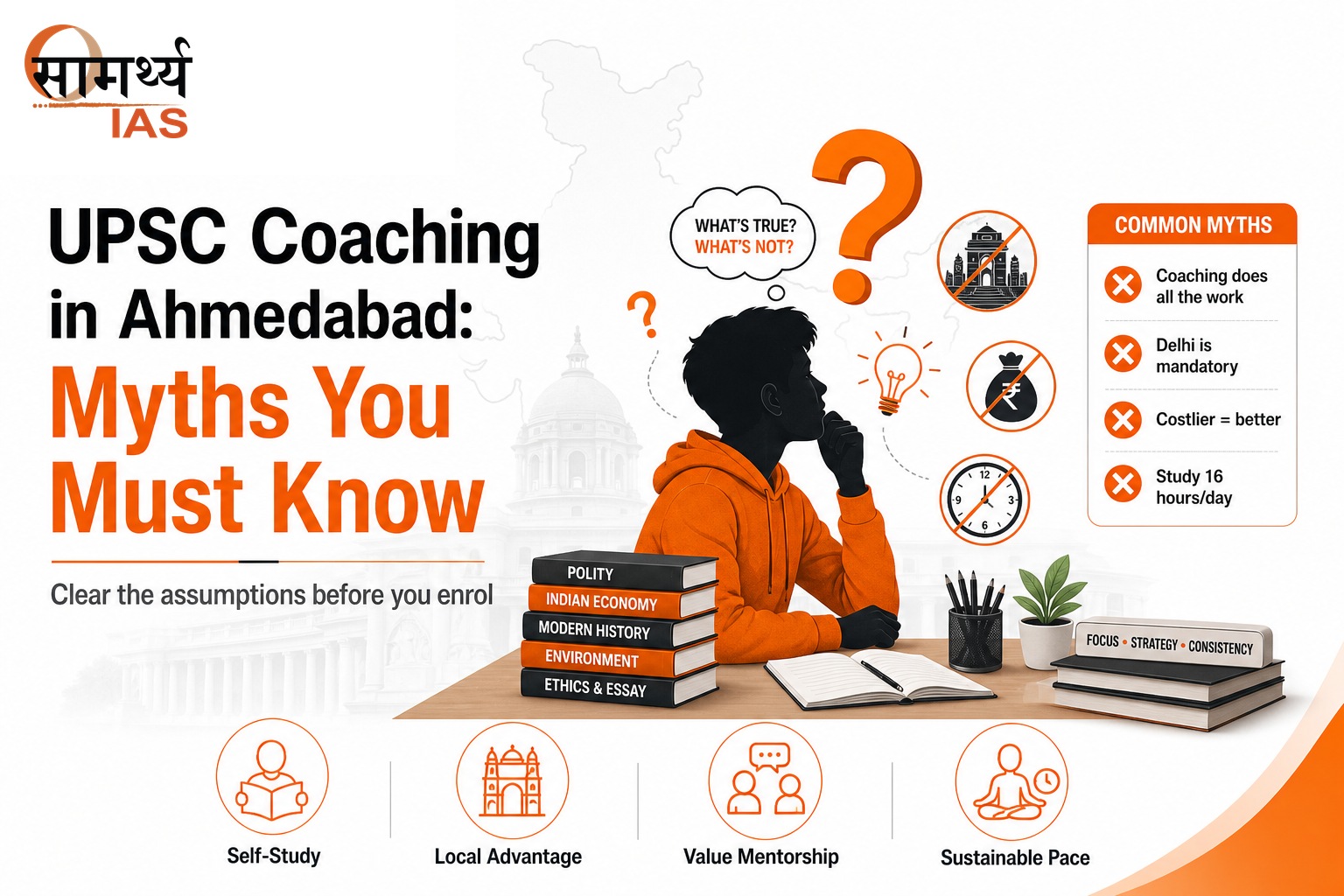
Each year, thousands of students from Ahmedabad make crucial decisions about their UPSC preparation — which institute to choose, how long to take classes, or whether coaching is required at all. An astonishing number of those decisions rest on assumptions that simply do not hold water.
These are not obscure misconceptions. They are everyday beliefs repeated in family conversations, on internet forums, and even inside training institutes. If you are serious about public service, clearing the clutter early will change how much effort you waste. Here is what really needs correcting.
A Good Coaching Institute Will Do the Heavy Lifting for You
Even the best UPSC coaching in Ahmedabad is a support system — not a shortcut around your own work.
This is the single most harmful belief students bring into their UPSC journey: that if you enrol at the right school, attend classes, and success will follow on its own. Faculty can simplify complex concepts in polity, help you understand answer-writing requirements, and build a disciplined study schedule. No class, however, can replace hours spent making connections between topics independently.
Students who treat coaching as passive — attending classes without a discipline of self-study — tend to stagnate at Prelims. Students who use the institute to build a foundation and then drive their own academic work around it move ahead. The institute gives you maps; you still have to navigate the landscape.
The “Delhi or Nothing” Trap Is Outdated Thinking
One of the most common beliefs — especially in first-generation aspirant families — is that UPSC preparation is only “valid” in Delhi or another national hub. That assumption pushes gifted students to travel unnecessarily, adding financial and psychological stress to an already demanding process.
In reality, high-quality UPSC coaching in Ahmedabad has grown in both depth and structure over the past few years. The curriculum does not change by geography. What matters is whether the institute has knowledgeable faculty, up-to-date study material aligned with UPSC’s changing patterns, regularly scheduled mock tests that are honest and fair, and solid Mains answer-writing guidance.
Preparing in your own city also brings real advantages: a familiar environment, lower living costs, family support, and the chance to form a close peer group. Those are not minor factors when an exam demands sustained focus for several years.
Assuming the Most Expensive Institute Produces the Best Results
How easy is doubt-clearing? What is the batch size? How are mocks assessed — written feedback or only scores? What support exists if you need to revisit subjects?
The idea sounds logical: if an institute charges high fees, it should provide the best training. UPSC results do not work that way. Fees often reflect brand positioning, infrastructure costs, or marketing — not always the quality of instruction or mentorship. Some of the most effective civil services training in Ahmedabad skips the overhead of a giant campus or celebrity faculty image and focuses on academics.
The ideal coaching setting takes each individual’s development seriously — not one that impresses you on day one and then moves you through as a group.
Thinking You Need to Study All Day to Compensate for Coaching
Another common misconception: if you are in coaching, you must study 14 to 16 hours every day to “make it count.” That usually comes from anxiety rather than strategy, and it often leads to burnout within the first few months.
UPSC preparation is a long course — typically 12 to 24 months across more than one attempt. Candidates who sustain quality preparation keep an achievable daily routine: consistent study hours, adequate rest, regular revision cycles, and planned breaks.
Good UPSC coaching in Ahmedabad helps you study more effectively by organising the syllabus into sensible patterns, highlighting high-yield subjects, and giving accurate timeframes. If the coaching atmosphere pushes anxiety-driven marathons instead of an organised approach, that says more about the environment than about your discipline.
Believing That Past Exam Toppers Had a Secret Strategy
The internet is full of topper interviews. Serious aspirants can spend hours hunting for an obscure formula on those pages. The search for a unique technique often distracts them from the obvious factors that actually drive success.
Asked honestly, most toppers describe strategies that sound simple: they understood the syllabus thoroughly before making notes, practised questions regularly, stayed consistent through low motivation, and used coaching to supplement independent thinking — not replace it. No hidden resource or method is being kept from you. The hard part is doing everyday things — reading, revising, writing, evaluating — at high quality for a long time. Coaching can structure the effort. Making the effort remains yours.
The Belief That Joining Late Puts You at a Fatal Disadvantage
Some students hesitate to enrol because they missed the “standard” start window — usually early in the year. They assume that beginning later means falling behind permanently.
That is not how UPSC preparation works. The syllabus is huge, but it is also cyclical: current affairs rotate, static topics are revisited, and the exam rewards depth more than speed. Many candidates who joined coaching later in their preparation and repaid the delay with focused effort cleared Prelims ahead of those who joined early but never studied thoroughly.
More important than the start date is how you plan the time you have. A strong coaching institute in Ahmedabad can help you build an effective schedule regardless of when you begin.
Expecting Coaching to Cover Personality Development for the Interview
This myth shapes how aspirants prepare for the Personality Test. Many ignore interview preparation during the coaching stage, hoping it will be handled later, or assuming the institute’s curriculum will take care of it automatically.
The UPSC interview assesses qualities that are not acquired overnight: intelligence, curiosity, insight into contemporary issues, the ability to answer complex questions calmly, and a clear sense of your own background and reasons. Those develop through deliberate practice over time — wide reading, mock interviews, and staying engaged with public discussion.
Civil services coaching in Ahmedabad can expose you to interview frameworks and DAF analysis. The persona you present to the panel, however, is built across your entire preparation — not in a two-week crash course before your appointment date.
Closing Thoughts
Choosing to prepare for the civil services is important enough to rest on clear reasoning — not on myths passed down as half-truths over the years.
Coaching institutes are tools. Used properly, they greatly strengthen preparation. Built on the wrong assumptions, they can waste even the best institution.
At Samarthya IAS, the approach to UPSC coaching in Ahmedabad is built on clear guidance, honest assessment, and coaching that respects the work this exam demands. Whether you are just beginning or rethinking your strategy, the most useful first step is asking better questions — about your habits, your personality as a learner, and what you actually need from a professional coaching setting.
Ready for clarity?
Ask better questions before you enrol
Talk to Samarthya IAS about an honest assessment of where you stand — and what a coaching environment should actually give you.