UPSC Preparation · Recommended Reading
Top 10 Books that Every Civil Service Aspirant Must Read
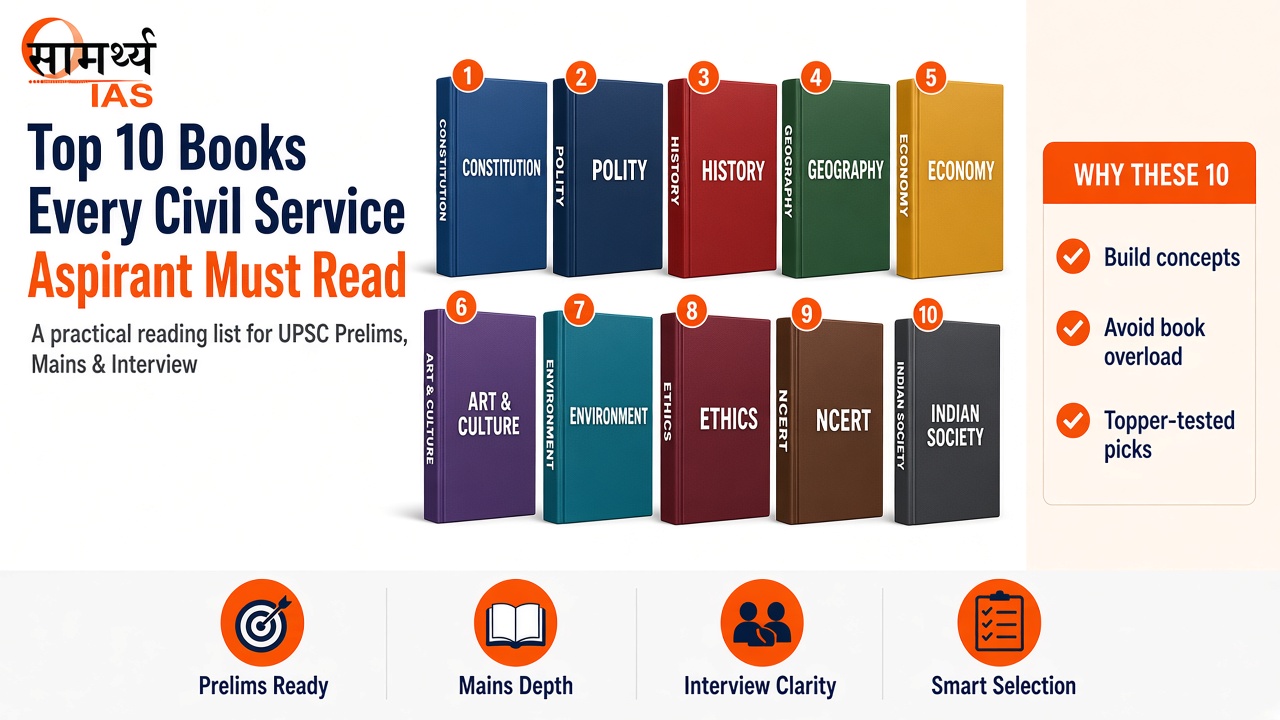
Walk into any bookstore near a coaching hub and you’ll find shelves groaning under UPSC preparation material — hundreds of titles, each claiming to be the one book that will get you through Prelims, Mains, or the interview. That abundance is actually part of the problem. Most aspirants don’t fail because they didn’t read enough; they fail because they spread themselves across too many books without mastering the handful that genuinely matter.
This list isn’t another generic roundup pulled from a syllabus PDF. It’s built around books that have earned their reputation over years of actual results — the ones toppers consistently mention, and the ones that build genuine conceptual clarity rather than just surface-level fact recall. At Samarthya IAS, we’ve watched enough aspirants succeed and struggle to know exactly which books deserve a permanent spot on your desk.
Why Book Selection Matters More Than Most Aspirants Realize
Civil services preparation isn’t like a college exam where cramming a single textbook the week before gets you through. It spans multiple stages, tests both breadth and depth, and rewards candidates who can connect concepts across subjects rather than recall isolated facts.
The wrong book choice doesn’t just waste time — it can actively work against you by building a shallow or inaccurate understanding that falls apart under Mains-level analytical questions or interview probing.
The books on this list were chosen specifically because they build durable, transferable understanding rather than just covering a syllabus checkbox.
1. Indian Polity by M. Laxmikanth
If there’s one book almost universally agreed upon across the aspirant community, it’s this one. Laxmikanth’s coverage of the Indian Constitution, governance structures, and political system is thorough enough to serve as your primary polity reference across Prelims, Mains, and even interview preparation.
What makes it genuinely effective is its structured, exam-oriented explanation of constitutional provisions, historical context, and contemporary relevance woven together rather than presented as dry legal text.
2. India’s Struggle for Independence by Bipan Chandra
For the freedom movement portion of your preparation, this book remains the standard reference for a reason. Bipan Chandra’s analytical approach goes beyond a simple timeline of events — it explains the ideological currents, strategic debates, and social forces that shaped India’s path to independence.
This depth matters enormously for Mains-level answers that require you to analyze causes and consequences, not just recite dates.
3. India Since Independence by Bipan Chandra
The natural companion to the previous title, this book picks up where the freedom struggle ends and covers post-independence India’s political, economic, and social evolution. Understanding this period well is essential not just for history questions but for grasping the context behind current governance structures and policy debates that show up throughout General Studies papers.
4. Certificate Physical and Human Geography by Goh Cheng Leong
Geography trips up more aspirants than almost any other subject, largely because candidates try to memorize facts without understanding underlying physical processes. This book builds that foundational understanding of physical geography, climate systems, and landforms in a way that makes the subject genuinely comprehensible rather than a list of disconnected terms to memorize.
5. Indian Economy by Ramesh Singh
Economics for civil services isn’t about textbook theory divorced from real-world application — it’s about understanding how policy, fiscal decisions, and economic indicators connect to governance. Ramesh Singh’s book strikes that balance well, covering core economic concepts alongside their practical relevance to Indian policy, which is exactly the lens Mains-level questions tend to demand.
6. Indian Art and Culture by Nitin Singhania
Art and culture is one of those sections that can feel disproportionately difficult given how much specific detail it requires — temple architecture, classical dance forms, literary traditions, religious philosophies. This book organizes that sprawling subject matter clearly enough that it becomes manageable rather than overwhelming, and it’s become close to a standard reference for this section specifically because of that clarity.
7. Environment by Shankar IAS Academy
Environmental and ecological questions have grown steadily more prominent across both Prelims and Mains in recent years, reflecting how central environmental policy has become to governance conversations generally. This book covers ecology, biodiversity, climate change, and environmental policy in a structured format that keeps pace with how frequently this subject area evolves with new international agreements and domestic policy shifts.
8. NCERT Textbooks (Class 6 through 12)
This entry might not feel like a single “book,” but it deserves its place on this list precisely because so many aspirants underestimate it. NCERT textbooks across history, geography, polity, and economics build the foundational conceptual clarity that every advanced reference book assumes you already have.
Skipping NCERTs and jumping straight into advanced material is one of the most common mistakes aspirants make — and it usually shows up later as gaps in basic understanding that more detailed books can’t fully compensate for.
9. Ethics, Integrity and Aptitude (GS Paper IV Reference)
The ethics paper is unlike any other section of the exam — it doesn’t reward pure factual recall; it rewards structured reasoning, real-world case analysis, and clear ethical frameworks applied to governance situations. A solid reference for this paper helps you understand foundational ethical theories, well-known case studies, and how to structure your analysis under exam pressure — a skill that genuinely improves with deliberate practice rather than last-minute cramming.
10. An Introduction to the Constitution of India by D.D. Basu
While Laxmikanth covers polity comprehensively for exam purposes, D.D. Basu’s work offers a more focused, legally grounded understanding of constitutional principles and their judicial interpretation. This becomes particularly valuable for Mains answers that require nuanced discussion of constitutional provisions and landmark judgments, giving your answers a depth that goes beyond what a purely exam-oriented reference provides.
How to Actually Use This List Without Getting Overwhelmed
Having the right books means nothing if you don’t approach them strategically. A few practical principles worth following:
Read static subjects first, then layer current affairs on top. Books like Laxmikanth and Bipan Chandra’s works build your foundational understanding. Once that’s solid, current affairs additions make far more sense because you can connect new developments to concepts you already understand.
Don’t read every book cover to cover in one pass. Most successful aspirants revisit these books multiple times across their preparation timeline, going deeper with each pass rather than trying to absorb everything in a single read.
Make notes as you read, not after. Waiting until you’ve finished a book to summarize it means losing detail and connections that were clear in the moment but fade with time.
Prioritize based on your current preparation stage. If you’re just starting, NCERT foundations and Laxmikanth take priority. As you move closer to Mains, ethics and constitutional depth become increasingly important.
Common Mistakes Aspirants Make With Book Selection
A pattern worth avoiding: constantly switching between multiple books covering the same subject, hoping one will suddenly make things click, rather than committing to one solid reference and building depth through repeated engagement and practice.
Similarly, skipping NCERT foundations because they seem “too basic” often backfires later when advanced material assumes conceptual clarity that was never actually built.
Key Takeaways
The right ten books, read thoroughly and revisited strategically, will take you further than fifty books skimmed once and forgotten. Each title on this list earns its place by building genuine understanding rather than surface-level exam tricks — exactly the kind of preparation that holds up under the pressure of Mains analysis and interview scrutiny.
If you’re building your preparation strategy and want guidance on how to sequence these books against your specific timeline and strengths, that’s exactly the kind of structured planning Samarthya IAS works through with aspirants at every stage of their journey — helping turn a reading list into an actual preparation strategy that gets results.
Reading list ready?
Turn books into a preparation strategy
Talk to Samarthya IAS about sequencing these titles against your timeline, optional, and strengths — so reading becomes results.