UPSC Preparation · Library Strategy
Why Government Libraries Are Becoming the New UPSC Coaching Centers
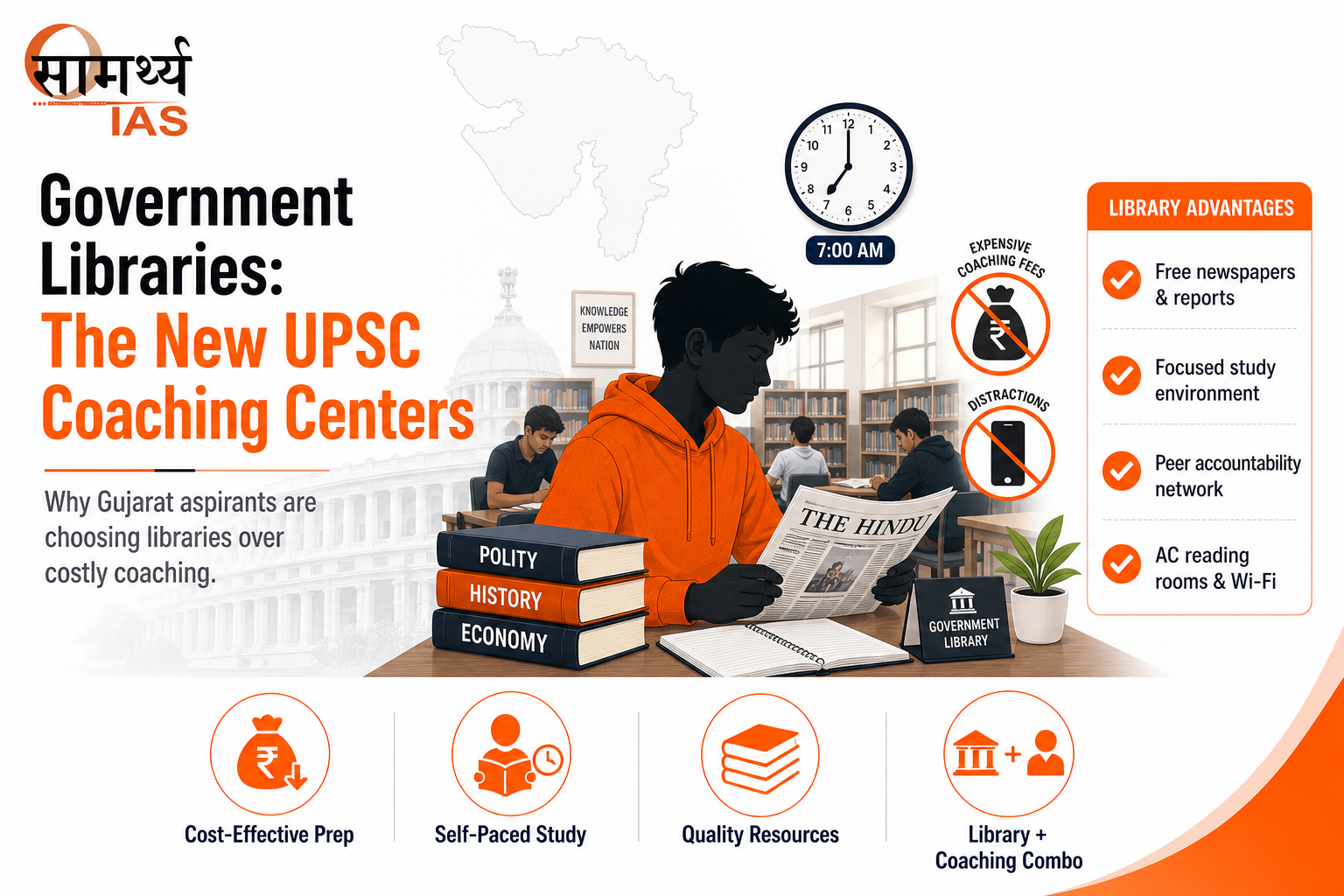
Visit the reading area at a clean, well-maintained library in any major city in Gujarat today, and you might be surprised. Seats are already filled by 7 a.m. Young people are noting down the newspaper, referring to Laxmikanth, and taking handwritten notes on governance and polity — staying till closing time. It is not a casual read. It is serious IAS preparation, happening outside the walls of every coaching institute.
The change is real and growing. Students looking for an IAS preparation institute in Gujarat are finding that a good library can provide something even the most expensive coaching programmes cannot always guarantee: fewer distractions, access to essential sources, and the quiet discipline of a peer group working hard every day.
The Coaching Cost Equation That Is Driving Aspirants Elsewhere
Preparing for UPSC is already a 2–4 year commitment. Adding Rs 50,000 to 2 lakh for a single coaching programme can create financial pressure that hinders preparation instead of helping it.
The truth is that most coaching centres are reluctant to declare what the exam itself makes clear: UPSC rewards the candidate, not the programme. In the Civil Services Exam 2025, 958 candidates were recommended out of the lakhs who appeared. What distinguished those who succeeded was not the institute they attended, but how thoroughly and consistently they studied over a long period.
Many successful candidates in recent years prepared through self-directed learning — standard textbooks, government sources, and routines structured around their daily lives. For a growing number, government libraries have become the foundation of that approach.
What a Government Library Actually Offers a UPSC Aspirant
The Ahmedabad District Public Library, Gujarat University Library, and the historic Gujarat Vidyapith Library — founded in 1920 by Mahatma Gandhi — are not just places to borrow books. Aspirants who use them seriously find resources that directly affect the quality of preparation.
Newspapers and periodicals — The Hindu, Indian Express, and government reports such as the Economic Survey and NITI Aayog publications — are among the least appreciated but most valuable library resources for UPSC.
UPSC Prelims and Mains both require sustained engagement with current affairs and official documents. Most government libraries carry these publications daily, at no cost — a significant saving over the course of a multi-year preparation.
The physical environment itself has a measurable impact. Research on study habits consistently shows that dedicated study spaces improve concentration and extend productive hours. A student at home, surrounded by household distractions, tends to achieve less focused time than one who travels to a library and sits among others working with similar intensity.
Peer interaction adds another dimension. Government libraries draw aspirants from different backgrounds and exam stages, creating informal networks where candidates exchange notes, share strategy ideas, and hold one another accountable — similar to the peer accountability coaching institutes charge for, but built naturally over time.
Why Libraries Are Evolving Into Something More Than Reading Rooms
Several government libraries across India — including in Gujarat and Maharashtra — are upgrading their reading spaces with features designed specifically for competitive exam preparation. Air-conditioned reading rooms, reliable power for laptops, Wi-Fi connectivity, and extended opening hours have meaningfully changed how many hours candidates can use these facilities.
Some libraries now host educational sessions, provide access to online databases, and maintain curated UPSC reference collections that reduce the need to buy expensive textbooks. Gujarat Vidyapith’s library, with more than six lakh titles, holds rare collections on social and governance subjects that are difficult and costly to access elsewhere.
The shift is not accidental. Library departments and state governments recognise that aspirants form a significant share of library patrons — and have responded with targeted infrastructure improvements.
The Honest Comparison: Libraries vs Coaching Institutes
Coaching institutes offer a planned schedule, faculty-delivered content, periodic tests, and classroom motivation. These are genuine benefits — especially for students starting from scratch or struggling to study independently.
Libraries, however, provide something classroom coaching cannot: self-paced, sustained, reflective work. UPSC Mains questions demand analytical thinking developed through slow, independent reading and reflection — not through attending back-to-back lectures. The library gives aspirants space to think, not just to receive information.
The most effective preparation combines both: structured guidance from an IAS preparation institute in Gujarat alongside consistent daily study in a library. Neither alone is as powerful as the two together.
A common mistake aspirants make is treating library time as supplementary to coaching — when in reality, it is often where the deepest preparation happens. Coaching gives you direction; the library is where you do the work.
What Aspirants Using This Approach Should Do Differently
The library-as-coaching-centre approach only works with the discipline of a structured programme. Simply showing up is not enough. Aspirants need a specific daily goal, a clear syllabus progression strategy, a method for integrating current affairs into static subjects, and a regular test series to identify and fix weak areas.
Start with a daily plan. Allocate fixed time blocks to specific subjects. Treat newspaper reading as active work — note GS issues, not just headlines. Set aside at least one session each week for answer writing, not only note-making.
Libraries do not create this framework for you. That is where guidance from Samarthya IAS becomes genuinely useful — not to replace library hours, but to structure them so every hour counts.
Conclusion
Government libraries are not a fallback for those who cannot afford coaching. They are a legitimate, increasingly well-resourced, and often under-utilised environment for dedicated UPSC preparation. In Gujarat, strong library infrastructure combined with a growing culture of self-directed exam preparation gives candidates more options than ever before.
Samarthya IAS works with aspirants who want structured direction while keeping control of their own study rhythm. The best preparation combines professional guidance with sustained, thorough self-study — and the ability to use every resource available, including the government libraries that are quietly becoming the new coaching centres of this generation.
Library + coaching?
Make your self-study hours count
Talk to Samarthya IAS about a preparation plan that combines structured guidance with the discipline you build at the library.