UPSC Coaching · Timing Strategy
Best Time to Join UPSC Coaching: Should You Start During College or After Graduation?
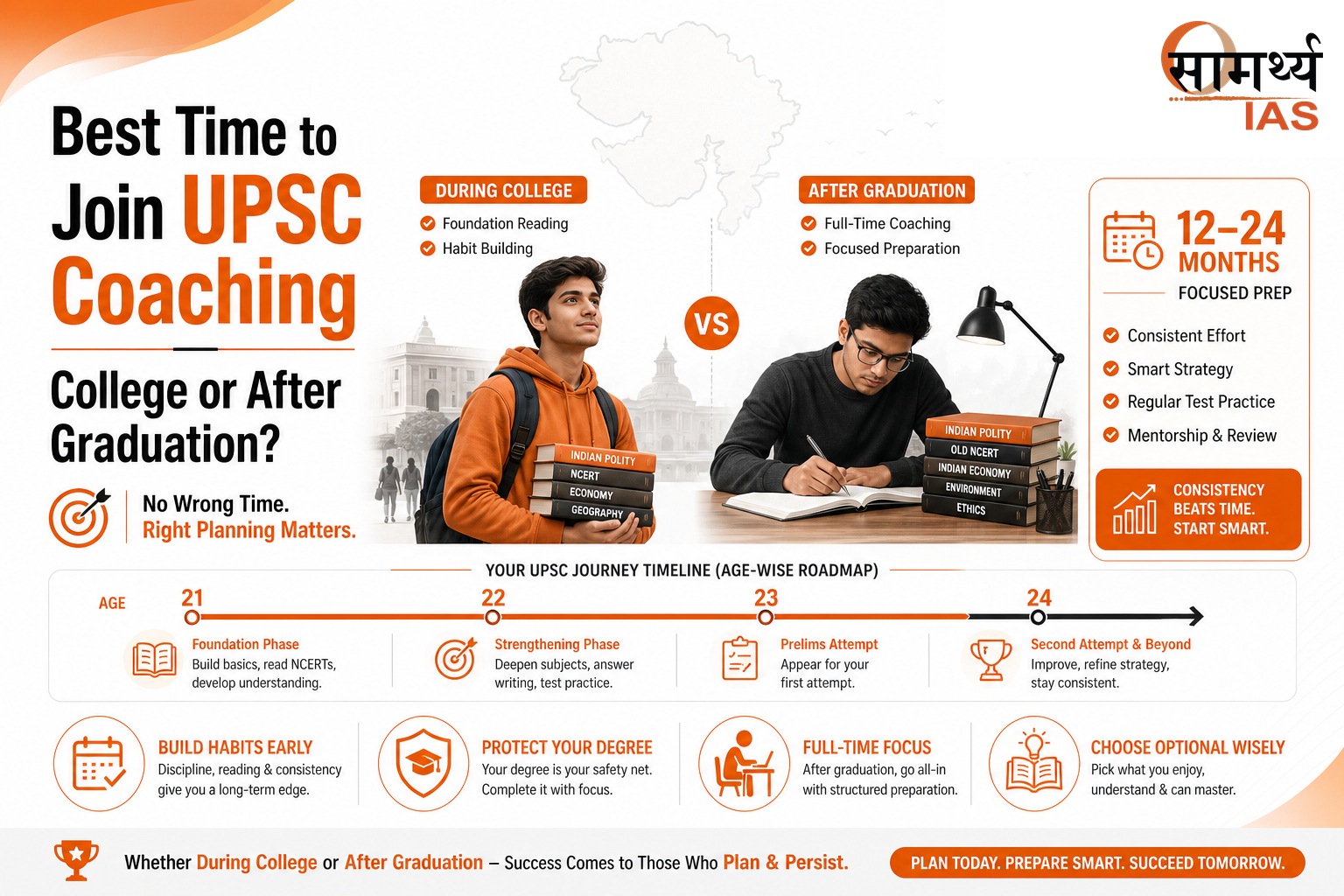
The most frequent question from candidates looking into IAS preparatory institutes in Gujarat is not which coach to sign up for — but when. That timing decision matters more than many students realise. Starting too early without proper foundations wastes time and money. Waiting too long can close windows you cannot reopen easily.
There is no one-size-fits-all answer. The ideal time to begin depends on the person, their educational background, and how clearly they understand what civil services training actually requires. This article is for Gujarat students who are serious about evaluating GPSC and UPSC coaching in Ahmedabad and need a logical basis for the decision — not a sales pitch.
What the UPSC Timeline Actually Looks Like
Ages 21–32 for UPSC CSE. GPSC Class 1 and 2 exams in Gujarat have their own calendars and age limits — the window is open, but not indefinite.
Before you decide when to start, understand the competition structure. UPSC allows a maximum of six attempts for General category applicants between ages 21 and 32. GPSC Classes 1 and 2 examinations in Gujarat each have separate timelines and age limits. The opportunity window is real — and finite.
A thorough UPSC attempt usually needs 12 to 24 months of focused study to reach a competent level, depending on prior academic exposure to History, Polity, Economics, and Geography. Students who already covered these seriously during undergrad sit in a different position from those who graduated in Engineering or Commerce with little overlap.
Seeing this timeline clearly is the first step. The rest follows.
The Case for Starting UPSC Preparation During College
There are real benefits to building UPSC awareness and foundations in the last one or two years of a bachelor’s degree — as long as it is done with discipline and without compromising academic performance.
The syllabus overlap is real. Students in Political Science, History, Sociology, Economics, Geography, or Public Administration can connect their curriculum directly to UPSC General Studies. Using those years to study standard texts such as Laxmikanth, Bipan Chandra, or Ramesh Singh — with both academic and UPSC goals in mind — gives a dual benefit that post-graduates do not get as easily.
Habit formation happens more naturally. Daily reading, following current affairs through newspapers such as The Hindu or Indian Express, and developing the methodical writing style Mains demands all take months. Starting in college means those habits are set before full-time prep begins.
First-attempt alignment can be strategically sound. If you graduate at 21 or 22 with solid foundations, you can be ready for a serious first attempt at 23 or 24 — leaving room if multiple cycles are needed.
College is for foundation work — not a full coaching load that competes with your degree. Students who sacrifice academics for UPSC often end up with neither a strong degree nor a strong exam base.
The Case for Starting After Graduation
For many students — perhaps most — starting organised UPSC coaching right after graduating is the most effective approach. Here is why.
Full attention changes preparation quality. Serious UPSC prep is not a part-time activity. The curriculum is extensive, revision demands are intense, and Mains plus interview work needs real mental energy. Students who commit fully after graduation — free of coursework, internals, and assignments — typically build speed faster than those splitting focus through college.
Optional subject selection becomes clearer. Choosing a Mains optional is one of the biggest decisions in UPSC preparation. It is wiser to make that choice after you have finished your degree and understand the depth of your own knowledge. Rushing into an optional during college on limited experience is a mistake that can cost dearly later.
GPSC aspirants have additional considerations. For those aiming at GPSC Classes 1 and 2, eligibility and exam calendars differ from UPSC. Many aspirants in Ahmedabad and across Gujarat take GPSC training alongside UPSC in a concentrated post-graduation phase, when dual preparation can be planned more efficiently. Combined GPSC and UPSC coaching in Ahmedabad works best when you can devote full time.
When the Decision Depends on Your Degree
The real answer to college versus post-graduation depends largely on which undergraduate stream you come from.
- 01 Arts and Humanities with strong curriculum overlap: Beginning foundation reading in the last semester of college is appropriate — if academic performance is not affected.
- 02 Science, Engineering, and Commerce: The adjustment to UPSC’s requirements takes longer. Starting immediately after graduating through a structured programme at a reliable IAS preparation institute in Gujarat is usually more efficient than splitting attention during college.
In both cases, the shift into full-time, serious training should happen after graduation — ideally without a long gap that lets habits slip away.
What to Look for When Choosing a Coaching Programme at Either Stage
Whether you enrol in the final year for foundational guidance or commit fully after graduation, the coaching environment matters. Look for programmes that offer organised test sequences with precise feedback, teachers who resolve individual doubts rather than only delivering lectures, an honest assessment of where you currently stand, and support for both UPSC and GPSC when a dual path is needed.
Samarthya IAS in Ahmedabad supports students at both stages — an organised path for those building foundations in college, and for those committing to full-time study after their degree. The approach rests on honest assessment and continuous academic guidance, not on empty promises.
Conclusion
The best time to begin UPSC coaching is when you are ready to take the process seriously, understand your objectives, and can give the commitment it demands. For most students, structured coaching begins after graduation; foundation reading can start in the final year of college if your degree allows it.
Timing is important. Commitment is more important. Assess your situation honestly, choose a programme that fits your stage — and start.
Ready to decide your stage?
Talk through your timing with faculty
Whether you are finishing college or ready for full-time prep, Samarthya IAS can help you choose the right starting point — without the sales pressure.